I wish Zach were taller so he could pee standing up.


Who decided that boys underwear should have a one-inch elastic band?

Toilet training a boy is harder than toilet training a girl.

Yes, Zach is still doing a great job with using the potty, and he’s not having accidents when he’s awake (although he still needs a diaper for his nap and he often likes to poop at that time, which sort of negates the fact that we’ve trained him, seeing as I’m still changing poop diapers … but as usual, I digress).

The problem is one of anatomy.  He gets himself to the little potty just fine.  He pulls his pants down, sits down, leans forward, and pees, happily, all over himself, or all over the floor, or some combination of the two.  Sometimes the pee pools in-between his legs because he’s got them together with his penis somehow wedged in the middle.  Then he stands up with pee dripping down his legs, looks in the nearly empty pot (as the majority of the pee didn’t end up in there), and says, “Pee pee poppy (potty) Mama!!!”

See, leaning forward seemed to be the only thing I had to teach Eliza in order for her pee to make it into the pot instead of out the front.  With Zach, I have to make sure I point his penis downward manually with a finger or, generally speaking, the pee is going to go everywhere.  He has not picked up on the need to do this for himself yet.  So though he is trained, it would honestly still be easier if he were in a diaper.

Earlier today he had to poop right when I needed to get to an exercise class.  Thus, I took him to the toilet at Eliza’s school before heading to my class.  He sat down, started peeing (into the toilet, with my help!) and got red in the face like the big business was happening.  And then the automatic flusher on the toilet went off for some reason.  (Freaking sensor malfunctions!)  As a side note, Eliza will not use a toilet with a sensor unless I cover it with my hands while she goes, because one went off underneath her and I believe it scared the $@)% out of her.  Well, Zach had the same reaction to the toilet underneath him.  I didn’t get to see if any poop came out before everything was flushed under him (as he reached for me and started whimpering about the whirlpool underneath him).

Then I dropped him off at the YMCA babysitting center, already late for my class, and figured I ought to try to be kind to the childcare workers and make sure he didn’t have to poop.  I sat him on the potty there, no more than 8 minutes after he had JUST PEED.  And of course I was hoping for a poop, and focusing on that, when I sensed wetness on my leg and looked down and immediately pushed his penis down because he started peeing all over me (and his clothes).  Of course, he didn’t poop.  Nope.  He did, however, poop in his diaper during his nap.  (That just happened.)

I can totally see why people say boys take longer to train.  I don’t believe that’s actually the case (based on my highly scientific statistical analysis of one boy and one girl).  Both of my kids took the same amount of time to train to hold their pee in and get to a toilet to release it.  The problem is not in the process; it’s in the anatomy.  It would be much easier to wait to train a boy until you can train him to stand in front of an adult-sized toilet, point, and shoot.

The reaction I get when I ask Zach to climb onto a stool to sit on the big toilet is exactly like what his reaction would be like if I asked him if I could give away his Thomas the Train.  So we have a long way to go before he’s standing and peeing (and I’m sure there will be accidents all over the seat rim then as well, especially when he discovers his powers to direct pee in every direction.)

The other boy/girl difference is in the underwear.  Girl underwear is designed to be easy to pull down.  It’s almost like the manufacturers know that girls are well-mannered and deserve to be able to get their underwear off.  Boys, on the other hand, have an inch-wide band of elastic around their waists.  I’m not sure what purpose this serves.  If it’s to keep boys from pulling their pants down and showing everyone their packages, it has worked.  If it’s to keep them from playing with themselves, it hasn’t, seeing as they’ve designed the cut-out hole so they can pee without having to remove the underwear.  I’m afraid to teach Zach about that hole for obvious reasons, and also because as previously described, he’s not standing and peeing yet.

So, he will continue to sit to pee for the time being.  I will continue to be there for each toileting experience so I can help him get the childproof underpants down, and so I can aid him in pointing his manhood in the right direction before  the pee goes everywhere.  If you have a son who’s still in diapers and you’re reading this, enjoy it.  Honestly.  I am announcing defeat – for the moment – on this one.

Zach is not peeing in peace


Here I sit in the second day of what is supposed to be “Toilet Training in Less Than a Day” with Zach.  I love the irony.  Greg did the training yesterday, as he did with Eliza.  And as with Eliza, we seem to be having some issues.

The book’s method makes so much sense to me.  It combines several types of teaching all-in-one to get a child trained quickly (learning without distraction, increasing urination opportunities, practice in walking to the potty, practice in required dressing skills, learning to relax before urinating, learning by imitation, learning by teaching, learning by manual guidance, increasing motivation to be trained, and teaching the attitude of personal cleanliness).  The problem so far has been that my children don’t seem to get a first successful pee on the potty (despite lots of time sitting on it).  So it has not been the wonderful, fun experience for either of them that the book promises.

Nevertheless, we persevere, because the point is I know he will be trained shortly.  Maybe it will be today.  Maybe it will be tomorrow.  And I’ll be sure to write more about it.  But as I’m in the thick of it, I thought I would update you.  There will definitely be more to come.  Here’s hoping for a good pee in peace this morning!!!

Someday, the war will be over, and our everyday battles will be a distant memory


Eating peas one at a time took too long. I preferred to get it over with, putting one on each spike of my fork per bite.

Some days my kids don’t eat.  What I mean is not a lot and not what I want them to eat.

I used to see parents out with their kids in restaurants, judging them for allowing them to eat bread, french fries and ice cream for dinner.  Now I’ve been there and done that to keep them quiet.  In my defense, we’ve taken the kids to some nice restaurants where I’ve weighed the unavoidable disapproving looks for malnourishing my children against those glares I would get if a tantrum about anything ensued (like someone using someone else’s crayon, or one or both not wanting to sit in a seat).  Malnourishment wins a lot of the time.  It’s called picking your battles.  Even at home, mealtime can be a mine field.

Me: “You can eat your dinner, or you can not eat your dinner, and then go straight up for a bath, without building a fort and without a popsicle.  It’s your choice.”

Eliza: “Mommy, I don’t want to build a fort.  I don’t want a popsicle.”

Seriously?  I know she’s lying.  But right now, I’m trying to deal with the not eating, so I can’t get into a discussion about whether she’s telling the truth because I have to deal with the consequences of her answer.  I cannot get sidetracked by her efforts to derail me.  So, we take her up for bed and that’s that.  She doesn’t eat.  My 41-inch tall, 31-pound daughter chooses to go without food.  (She might get to move out of her car seat and into a booster by her sixth birthday.)  Zach refuses to eat any part of his dinner about half of the time.  The pediatrician assures me that he must be getting enough in the earlier parts of the day.  But how infuriating it is that he won’t even taste what I’ve cooked!

I remember my childhood.  I remember secretly feeding my veggies to the dogs.  I remember refusing to eat.  I also remember my parents threatening to reheat the food for breakfast if I didn’t eat it right then (and they did).  When I realized they were serious, I started negotiating.  “I’ll eat 3 peas.”  “No, Christine, eat 20 peas.”  “Four.”  “Ten, and that’s final.”  And then I would hold my nose and gag and make all sorts of crazy torture-enduring faces at them while I drank the peas down with milk.  And now?  I actually like peas.  And I enjoy most of the vegetables I didn’t like as a child.  I grew up and had to make a decision about whether I wanted to live a healthy lifestyle or not.

Someday I’m going to look back and see that the truth is, my kids get food.  They get nourishment.  The probably get more calories each day than 80% of the people in this world.  Could they do better?  Sure.  Everyone probably could.  But there are actually kids who don’t have enough food.  And there are actually kids who don’t eat, like they must be intubated to get the nutrition they need.  I saw a news story on it once.  Those are real problems.  What I face is … annoyance and a lack of control.  (Welcome to parenting 101.)

Thus, I’m hopeful that if my kids see Greg and me eat well, they will grow up to eat well.  I hope they one day make good food choices on their own, because at ages 2 and 3, they aren’t capable of it.  And that’s okay.  I have to stop looking at all these obstacles (they don’t eat, they don’t sleep, they fight, they’re defiant) as battles.

Instead, they are opportunities for growth.  I’m here to teach them to make good food choices, and teach them how to behave and have self-control even when they’re tired (hmm, am I capable of that?), and teach them how to value putting others first, and teach them to be agreeable or others won’t want to be their friends.  (And okay, that sometimes, a person is just asking for it and that’s when you slug ’em.)

Someday they will not be children any more.  They will still be mine, but my prime time for parenting will be over.  So I want to get over the random days they don’t eat and realize that this, too, shall pass.  It’s not letting them win the battle, it’s giving up fighting at all.

When our kids are being bad, we must not miss the good


Mute, pause, stop, power off ... these would all be useful buttons for our children.

It would be so nice if we could have remote controls for our kids.  I think I would use “MUTE” quite a bit.  It would be awesome if you could custom-tailor them to your needs.  Mine would have a button that makes them enjoy vegetables.  And one that keeps them from picking their noses and eating their boogers.  And there would be a button I could hit to make them do exactly as they’re told.

This morning I had my mom’s group, and we currently do not have a babysitter to help out.  Thus, there are five 2- to 4-year-olds who we basically ask to go down to my basement and play together for two hours.  I’m actually amazed we get to have any time to talk when I think about how ridiculous a request this is of children that age.  Thus the kids come up several times and we take turns directing them back to the basement and taking care of the “he hit me” and “she didn’t share” issues.

Today, while one of the mom’s two boys were up with us and eating our food, I confess I was a bit annoyed they were upstairs and wanted them to go back down and eat their snacks, not ours.  And then the older brother said to his little brother, “Hey Timothy, would you like some cheese?”  And he proceeded to cut a large slice of the little bit of brie that remained, and then he handed it to Timothy.  And of course that was when their mom (like I would have done) took the piece of cheese away and directed them back down to the basement.

Now that it’s nap time, I have had a few moments to think back on that moment and realize how beautiful it was.  Yes, the boys had come upstairs to be with their mom, even though we had asked them to stay in the basement.  But the older brother was taking care of his younger brother; he was putting him before himself.  He was clearly enjoying the brie, and even though there was very little of it left, he offered it to someone else.

And I sit here wondering how often I miss the good in the middle of the bad.  And bad here isn’t necessarily bad.  In the moments when I’m not able to control them (because they do have minds of their own) and not getting what I want, am I seeing the growth?  Do I praise and reward them when I see their hearts reflecting goodness, kindness, or gentleness, in the middle of disobedience?

I am not even sure that I would call the children’s visits upstairs disobedience because they are too young to be left alone and they need a lot of guidance.  Our children needing us shouldn’t be annoying (though I sometimes allow it to be).

I think, in retrospect, I’m the one who needs the remote control: one that turns off my selfishness.  And one that enables me to step beyond how I feel in the moment – a pause button – and opens my eyes to all the good my kids show me, each and every day.

Parenting lesson #4: Your to-do list will never be the same again


If you’re a mom, it’s more like 10 or 10,000 things

There is nothing that will re-prioritize your life like having children.

Your to-do list expands overnight when you’re pregnant and you feel the pressure to read the countless books there are on hosting your little human parasite, birthing it and taking care of it.  Once you have the baby, your to-do list is almost entirely decided for you.  You never know how much time you’ll have before the baby needs you, so you have to decide whether to take a nap (as everyone advises), do laundry, eat something, do the dishes, write thank-you notes, or somehow try to feel like a normal person by talking on the phone to someone or e-mailing.

When I went back to work, the weekends became a juggling act of errands, going through mail, and trying to have “family time.”  Personal, pre-children projects like scrapbooking (laughable!) weren’t even in my “top 200 things I want to do list.”  When I quit my job five months later, my priority became figuring out what to do with an 8 1/2-month-old who couldn’t have a conversation.  Then I found out I was pregnant.  Of course, our biggest to-do list item became getting our personal wills done, as the thought of the government deciding what to do with our parent-less child would have been an overwhelming one without pregnancy hormones in play.

When Zach came along, my priority was surviving.  My to-do list was to -NOT-die, and not accidentally kill or maim either of my children from lack of sleep.  Honestly, the first few months of Zach’s life are a complete blur.  I wish I had started blogging then, but even the idea is ridiculous because, well, when could I have done it?

And here we are, with a 3 1/2-year-old and a two-year-old, and things seem a bit more manageable, but now my to-do list has more weighty items on it, like teach the kids to swim, figure out how to build Zach’s character, and research where we should send Eliza to kindergarten (because that decision is, scarily, a year away).  And of course, the scrapbooking from pre-baby days has fallen off the list, because it’s never going to get done.  I’ve come to terms with that.

The thing is, having kids pushes a lot of things you thought were important in life out of the picture.  And kissing them goodbye in return for newborn cuddles was a really tough pill for me to swallow.  I like control and I like thinking about myself.  But what I’m coming to realize is that I’m just beginning to understand what’s really important, and our kids are showing me that.  I am sitting here trying to think of what my normal, after work to-do list was like before we had kids, and I can’t even remember (maybe planning home improvement projects?).  I think that is more evidence that a lot of it didn’t matter; it isn’t lasting.  What’s lasting is leaving a legacy of children who will love others like we love them, and care about others like we care about them.

So if your to-do list is currently diaper-changing, spit-up cleaning, and round-the-clock feeding, hang in there; it will change again pretty soon.  Perhaps not to something easier, but at least, in my opinion, to something more rewarding.

I’m forever changed, and I wouldn’t ever want me – or my to-do list – to be the same again.

Never will I ever again … please learn from my mistakes, part 1


1. buy flip flops for a two-year-old: What on earth was I thinking when I did this?  I let Eliza pick out her shoes before heading out to lunch with her and Zach at 9-months.  Of COURSE she picked her flippy floppies.  When you’re carrying a diaper bag and a 20-pound blob, you really need your two-year-old to be able to walk well, especially when tree trimmers have blocked off the 18 parking spaces near the restaurant to which you are headed and thus you have a good 50 yards to traverse.  Eliza slowly, saunteringly, made her way with me.  It was unsafe, because she loves to annoy me even more by doing exactly the opposite of what I request when she can tell I’m frustrated.  This put her at risk for darting out (as best she could with those dang flimsy chicken wishbone plastic thingies holding the foam to her feet) into traffic.  After this incident, I officially hid them.  Incidentally, she found them at age 3 and I can say she’s much more adept at walking in them now.

2. go out without some sort of snack for both kids: Kids will not be hungry when you want them to eat, and they will swear they are starving when you have nothing to feed them.   I keep age appropriate snacks in my minivan and generally something in my purse.  Often, I’m the one who ends up needing the food anyway, because let’s face it, we moms forget to eat.

3. go out without diapers: I generally keep about 4-6 diapers in the car.  When I used a diaper bag, I kept 4-6 in it and two in the car.  My breastfeeding class teacher told us how she was stuck on an airplane with her baby who had diarrhea and – you guessed it – she ran out of diapers.  I figure I am saving myself from the experience by being prepared for it.  (If I didn’t always have that many diapers with me, I know Zach would get diarrhea.)  We have all been there.  Every once in a while, I end up using all the car diapers and forget to replenish the supply.  I was so embarrassed a few weeks ago when I took Zach to the church nursery and forgot to bring diapers.  Of course, he pooped.  (But the people who run the nursery have kids and, thus, they know to keep diapers on-hand.)

What lessons have your kids taught you?

Parenting lesson #2: Friends don’t tell you what it’s like to have a newborn because they can’t.


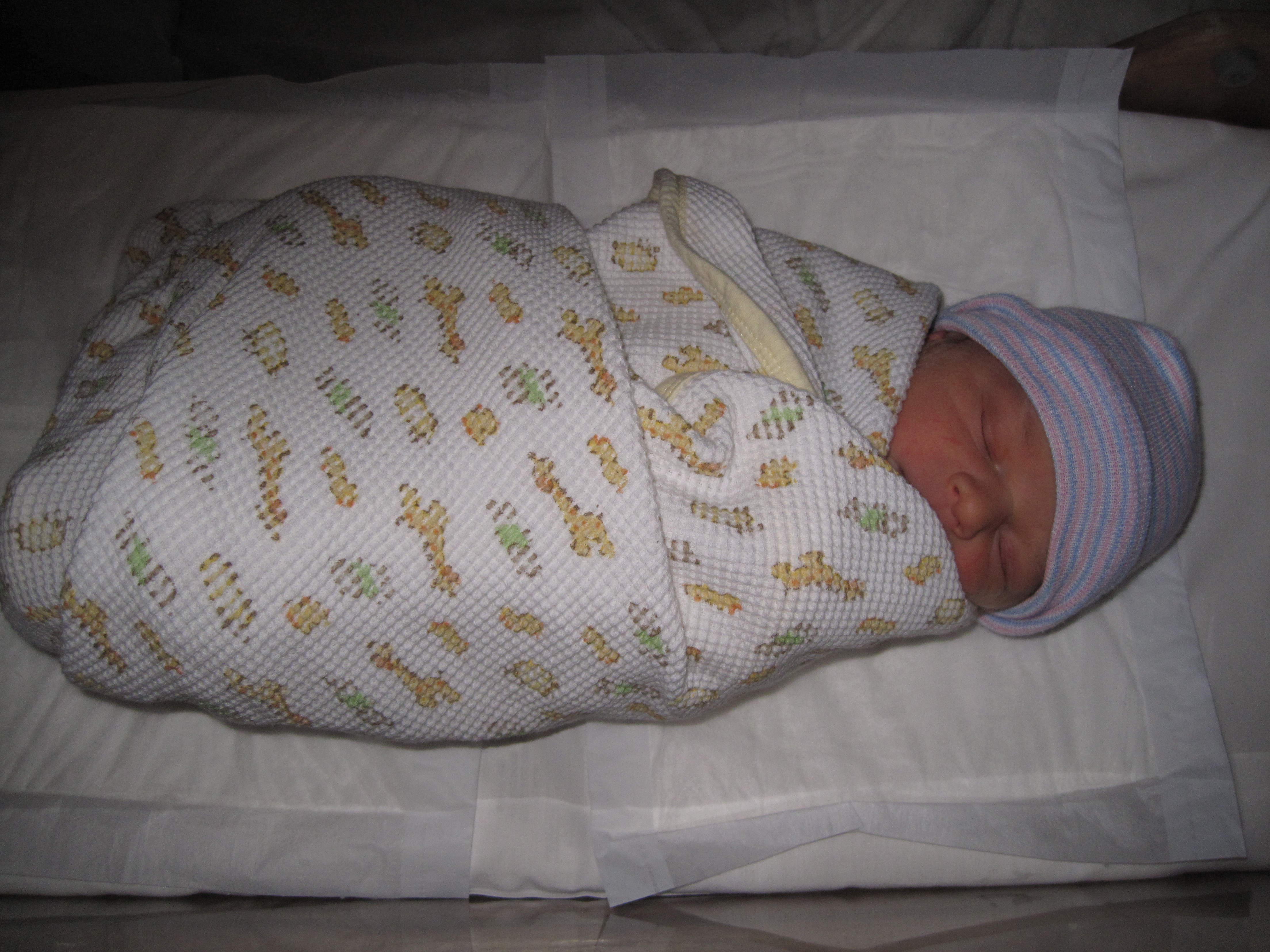
Zach, all swaddled in the hospital

“Why didn’t anyone warn me?” I wondered to myself over and over in the early days with a newborn.  How could having a baby be so hard, despite attending breastfeeding and infant care classes?  How could two educated parents be so clueless?

The answer, I have come to realize, is three-fold.  For one, friends did reveal the truth to me to an extent, and so did the birth and baby books I read.  But like anything that’s hard (like training for and running a marathon, or making it through medical school, I imagine), people can’t fully make you understand it with words and warnings.  Going through it yourself is the only way to truly “get it.”

Second, when I was struggling, I wanted to talk to others who had struggled.  Crying on the phone to my childless friends about being tired, feeling trapped and not producing enough milk just wasn’t as comforting (or baggage I wanted to unload on someone who was hopeful to have children some day).  I needed to talk to people who could relate, who could promise me I would come out the other end of the exhaustion and struggle.  I think this means that we don’t get the real scoop before having a baby.

The third reason is that I have a few friends who have had their babies and everything has been dreamy – they had easy labors and deliveries, their babies were perfect little eating and sleeping angels, and for these friends, life was just beginning.  (Haters.)  Every family’s experience is so different, even from child to child, that trying to warn people about how bad it could be doesn’t make sense.

All of that said, there are some aspects of becoming a parent that are universal.  So, if you want to know what to expect (no matter what), here’s what I can promise:

1. Bleeding: I was left in wonderment at how I was supposed to think missing 8 periods was so glorious when, once I had Eliza, I got all 8 missed periods in a row (and then some).  Having a baby makes you bleed.  A lot and for a long time.  I’m talking about gelatinous clumps in the first 24-48 hours that make you wonder if you’re going to lose all your blood.  (And you can’t use tampons.)  The good news is that you get these really cool disposable net panties from the hospital or birthing center that you can throw out along with the elephant-sized pads you are provided.  This is one of the reasons many postpartum women are anemic, so it’s important to continue taking pre-natal vitamins for the first few months, even if you’re not breastfeeding.  (As a side note, my friend who just had a C-section was under the impression that she wouldn’t bleed because when they went in after the baby, they’d get that out, too, along with – in her dream world – a few pounds of extra stomach fat.  She had no such luck.)

2. Pain: Whether you have a C-section or a vaginal birth, there is pain after expelling another person from your body.  It’s not like the baby comes out and you prance out of the hospital like the sugar plum fairy.  They wheel you out in a chair for a reason.  And healing takes time, too.  You might be on acetaminophen, or you might get heavy duty drugs.  If you get heavy duty ones, they might be powerful enough to make you forget that you are wearing the aforementioned netted panties.

3. hormone changes: Some hormone levels drop instantly after a baby is born, and some take a few months to normalize.  Almost all women experience some form of “baby blues” (isolation, fragility, and crying) for the first couple of weeks.  If you are one of the few who doesn’t, you’re also a hater.

4. Engorgement: Whether or not you end up nursing, your breasts will assume you are.  Thus, you will experience engorgement, which can be described as a burning hot pain along with super rock-hard breasts that have filled up with milk.  If you don’t want to nurse and you express the milk by pumping, your boobs will keep making more milk, so you just have to suck it up and let them leak and cause pain for a few days.  If you are nursing, you will go in-and-out of engorgement as your body tries to figure out how much milk to produce to meet your baby’s needs.  It’s really awesome when your newborn starts sleeping longer stretches (like 3 or 4 hours) but your boobs wake you up anyway because they’re engorged, anticipating a feeding.

5. No exercise or sex:  At the time when you’re in physical pain and hormonally imbalanced, when a good surge of endorphins would certainly help, you can’t exercise and you can’t jump your husband.  The truth is, for the first 6-8 weeks, you won’t really feel like doing either anyway.  (And if you thought you didn’t want your breasts fondled during pregnancy, it’s a whole new ball game if you’re nursing, seeing as you could leak or spray milk at just about any time.)

6. You will be able to see your vajayjay again, but you’ll be sorry you looked past your flabby, gelatinous belly to peek at it: No further explanation is needed.

7. Eat, sleep and poop:  Granted, your child might not do them in that order, and the frequency of all three ranges from child-to-child, but for the first 6-8 weeks, it’s really all they do.  Then they add smiling to the mix.  (Yeehaw!)

8. Eating is the most important:  Oh my gosh, a newborn’s stomach grows from the size of a marble to the size of a walnut in the first week of life.  Then the growth spurts start.  The old saying, “Let a sleeping baby lie” is detrimental to your child’s health in the early days.  You have to wake them up to feed them sometimes.  They must eat at LEAST 8 times a day, but it’s normal for them to eat as many as 12.  For several weeks.

9. You will fear the baby is not getting enough to eat:  It is unnerving to be responsible for the survival of another human life, and not knowing how much a child is eating and only being able to gauge it by whether the thing is peeing and pooping can be anxiety-inducing, especially for type-A folks.  Your pediatrician and/or lactation consultants can help you, so don’t be afraid to ask.

10. You will be afraid you are going to hurt the baby: On our first pediatrician visit with Eliza, Kathy, our lactation consultant, was hurling our baby around as if she were Gumby, bending her into different poses and manhandling her.  She was trying to show us how sturdy our love bundle actually was, and that it’s pretty hard to hurt them when they’re so nimble.

11. Exhaustion: Because of 1-9, you will be more tired than you’ve ever been in your life.  (Thanks Dana!)

12. Love overload:  Yet despite all the above, it is impossible not to be in awe of what God has created through you and another person.  There is so much warmth inside on an entirely new level when you nurture a newborn.  There’s no way to recreate it and bottle it up, because if I could, I would, and then I’d sell it on eBay and become a bajillionaire.  And I believe you still experience this, regardless of your level of postpartum depression (it just might be more in moments than all the time).

There you have it.  And I’m sure I’ve forgotten a lot because I’ve read that some of those hormones make you forget how hard it can be.  (Please feel free to fill in my gaps by commenting.)  To the childless, consider yourselves warned.

Parenting lesson #32: You can teach little children honesty before you can teach them tact


Truth is paramount.  I keep telling Eliza and Zach how important it is to tell the truth, mostly so Greg and I can help them, protect them, and teach them.  I’m learning that it would be nice if you could teach children to be honest while at the same time tactful.  Whereas honesty is pretty black and white to a child, (“Mommy, that lady right there is really fat”), tact, I’m finding out, is going to take longer to teach.  (Sometimes people don’t ever get it right.)  We have to be able to teach what facts and information are important to divulge.  (Okay, maybe even I haven’t figured this one out yet.)  And sometimes truth worked out in the logic of a 3-year-old’s mind is simply hilarious.  I think part of the reason watching children between the ages of 2 and 4 is so entertaining is because, as my mom has always said, “they say the darnedest things.”

A few weeks ago we were staying with some friends, and I introduced the kids to “The Banana Song” by singing everyone’s name in the car to the tune.  Both kids loved it.  Eliza said she wanted to sing it, but she just couldn’t do it.  Then she said, “Maybe I can sing it when I’m older, when I have hair in my hiney.”  I then proceeded (as I felt compelled) to explain Eliza’s understanding that you get hair “down there” when you’re grown up.  (See, perhaps my children are doomed as far as learning what to divulge and what to keep quiet.)

Then we were in Florida with family, and while we were all together, we made a Thanksgiving meal and celebrated the holiday early.  My older brother, John Henry, is known for being a bit verbose when telling stories.  As he had just returned from a hunting trip, he wanted to share some tales.  He was in the middle of telling a story about how this deer and cat faced off, providing specific, colorful explanations of every move each animal made, when Eliza said, “Excuse me Uncle Henry, can you just tell me what happens in the end?”  We all burst into laughing fits.

In this stage, we are all really getting to enjoy watching the wheels in the kids’ minds turn as they think through things and then verbalize them (in Zach’s case, through babbles, a handful of words and facial expressions).  As I’ve said before, I have three different notebooks around the house where I try to remember to jot down the funny things they say so I have a document of them.  As long as you write things down somewhere, you’ll be able to remember them.  Then you can keep a shoebox for each child so you at least keep the memory.  We also set up e-mail addresses when our kids were born, and we send them e-mails to document milestones, write them love letters and memorialize the great moments.  Because the truth, especially if it’s funny (or blackmail material down the road), is worth remembering.

The scoop on “Deceptively Delicious”


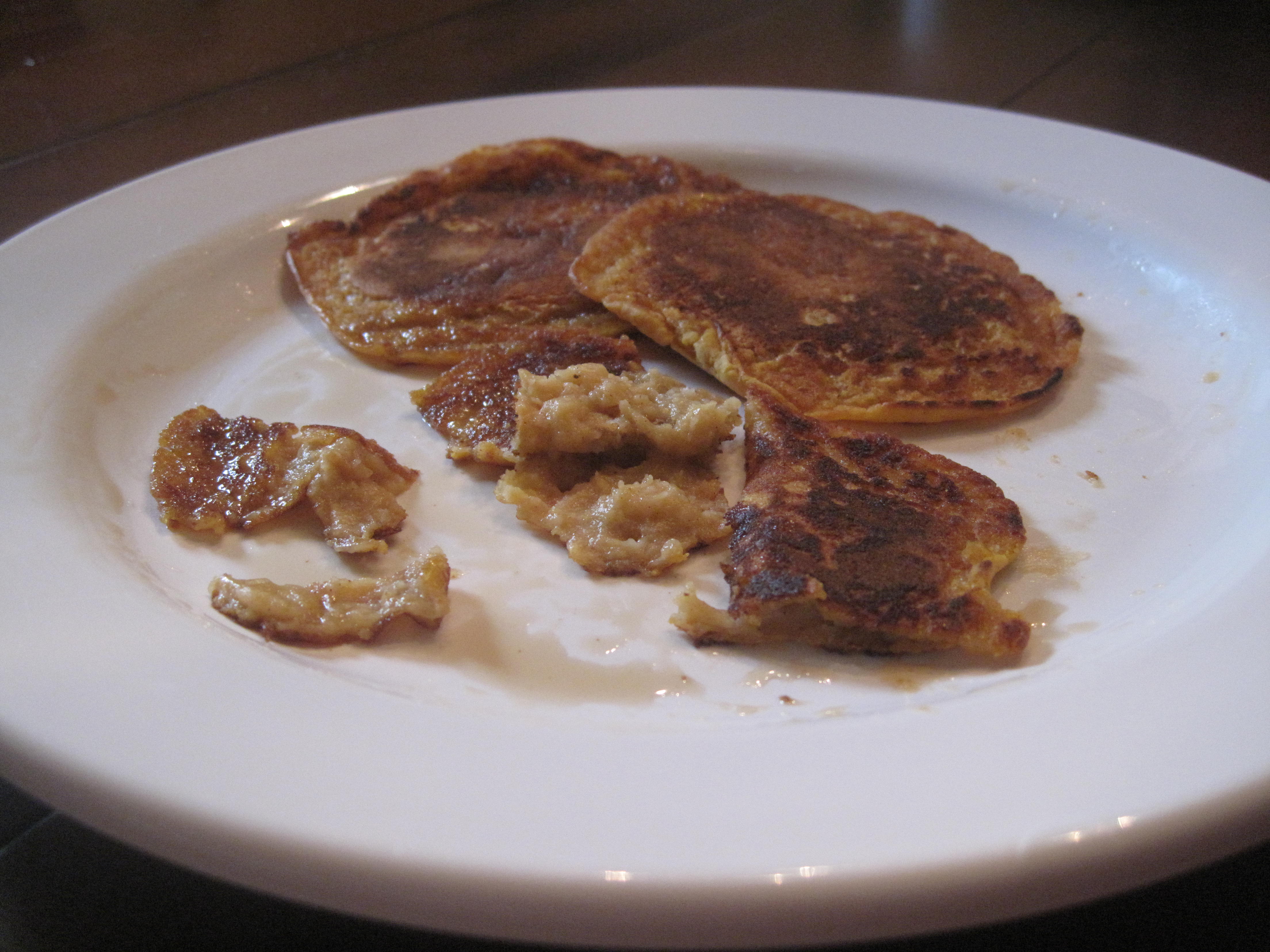
Sweet potato pancakes (well, sort of)

I’m willing to do just about anything to get my kids to eat the foods they need.  I have made up songs and dances about eating.  We get Eliza to eat by telling her the food will make her “BIG AND STRONG” as we all raise our arms and flex our muscles.  (Annoyingly, Zach likes to do this, but it doesn’t encourage him to eat.)  I have really enjoyed using “Deceptively Delicious” by Jessica Seinfeld to sneak veggies and other nutritional foods into their bellies.  I’ve probably tested at least half of the recipes in the cookbook, so I wanted to give my “review,” if you will, of the book thus far.

1. Yes, I would recommend it.  If you have general cooking knowledge, you can easily follow the recipes in this cookbook.  Additionally, all of the baking recipes I’ve tried have been fantastic and I love thinking that my kids are getting a little extra nutrition from their sweets.

2. The “fried” recipes don’t work so well: Chicken nuggets (p.75), mozzarella sticks (p.91), aloha chicken kebabs (p.95), and tofu nuggets (p.100) haven’t come out like I’d hoped.  I did change the chicken nuggets recipe substantially to make it work better.  I’ll send that out in a different post.  But generally speaking, vegetables mixed with egg don’t really stick to the foods very well, and thus the breadcrumb coatings don’t stay on very well.

3. These recipes work well and are easy: French toast (p.49), oatmeal (p.68), pita pizzas (p.96 – you can also use broccoli),  tortilla cigars (p.144), avocado spread (p.136  – this goes well with the tortilla cigars or tacos), tacos (p.148 – they’re just a little advanced for our kids still), chocolate pudding (p.159), chocolate peanut butter dip (p.163), frozen yogurt pops (p.167), and chocolate fondue (p.174).

4. My family’s favorites: Meatball soup (p.72), Italian meatloaf (p.79), mashed potatoes (p.80 – and you can add parsnips instead of cauliflower), beef stew (p.83), buttered noodles (p.108), burgers 2 (p.115), spaghetti pie (p.116), and lasagna (p.131).

5. Great baking: Banana bread (p.54), peanut butter and banana muffins (p.58), brownies (p.156), doughnuts (p.160), carrot cake muffins (p.185 – so moist and you don’t even need the frosting), and yellow cake (p.186).

6. I can’t get these to work: Pancakes (p.57) and pink pancakes (p.143).  See the photo above, but I am seriously wondering if these are missing the eggs.  I’ve tried to cook these as flat as possible, but still they don’t seem to cook on the inside.  I’ve cooked them up to 15-20 minutes total (and they’re supposed to take about 5).  I will not try them again unless perhaps with egg to see if that helps.

7. These are not tasty: tofu nuggets (p.100 – they’re just gross), burgers 1 (p.111 – everyone said they tasted like veggie burgers, but I liked them), and grilled cheese sandwiches (p.135 – maybe if you severely cut back on the amount of veggie puree).

Those are my initial thoughts.  I have a lot more recipes to try, and I’m thinking of getting Jessica’s second book, “Double Delicious: Good, simple food for busy, complicated lives.”  If you have either of these books and can recommend recipes or share tips based on what I’ve found, please comment!

How to answer the 187 “Why?” questions a day


There’s something simultaneously endearing and obnoxious about a “Why?” child.  Endearing (in my opinion) perhaps because I was one.  Obnoxious, perhaps, because now I’m getting a taste of my own medicine with Eliza.  I even think Eliza might be more of one than I was.

And yes, there is an innate curiosity that you don’t want to stifle by ignoring the incessant questioning of “How?” and “What?” and “Why?”.  But there is also a point at which you cannot answer everything.  More importantly, would you want to?  I want to teach my children to think through things before they ask about them.  I also don’t want to encourage them to be attention hogs or let them know that they get under my skin.  When I was young, I figured out I could use “Why?” to get attention from my dad, and I enjoyed how I could control him with that simple, one syllable word, watching him go from cooperative with the first “Why?” to indifferent (come the 2nd) to annoyed (the third) and finally angry in a matter of seconds.

So, I find myself constantly trying to come up with thoughtful answers to the daily barrage of question darts.  Here they are:

1. Why/What do you think?  I use this one a lot, especially when I believe she can reason through an answer on her own.  And if she was just asking the question to hear herself talk, this stops the conversation.

2. Why not?  Similar to the first, if she asks me why I picked out a certain shirt to wear, I might not really have a reason, and this response helps bring out interesting conversation.

3. That should be obvious.  I thought I was a genius the day I started responding with this, because it immediately stopped about three “Why?” attacks.  But the fourth time, she then asked, “What does obvious mean?”  Now that she knows what obvious means, this phrase is another tool in the toolkit that stops her and makes her think.

4. I’ve already answered you (or I’ve already explained it).  When I say this, sometimes it works, but sometimes she’ll then say again, “But why, mommy?”  That’s when the next one comes in really handy.

5. I’m done answering questions right now.  This one’s great for when I’m particularly exhausted by her interrogations.  I used to say, “I don’t feel like talking right now,” but when I said that, she would respond with – you guessed it – “Why mommy?”  So If I say I’m not going to answer any more questions, it communicates that it really doesn’t matter if she keeps talking.  I’m not going to respond, so she gives up.  I reserve this for when I really need it.

6. Are you talking just to talk?  She sometimes responds, “Yes,” to this, which gives me an opportunity to talk to her about not always needing to be the center of attention, and allowing others a turn to speak.

If God has blessed you with an inquisitive child, and you have magical solutions, please share them with me.  Why, you ask?  Aww shucks, I just decided I’m done answering questions right now.