The joys of pregnancy: uncontrollable crying


Violet Crawley“I’m a woman, Mary, I can be as contrary as I choose.”  – Violet Crawley, Dowager Countess of Grantham, to her granddaughter, Lady Mary Crawley, in Downton Abbey.

And I will add that there is never a time when a woman is more contrary, irrational or emotional as when pregnant.

We keep a thankfulness journal as a family, and at dinner we talk about something for which we are thankful and write it down.  Last night, Greg said he was thankful that he is not the one who has to be pregnant.  Here’s why.

Yesterday Greg helped me remove everything from our minivan (car seats, donation items, stroller, etc.) so I could go get it washed and vacuumed.  I went to our usual place around 2 p.m. to find a crazy line.  The big banner with hours listed said it was open until 6 p.m.  I decided to go back around 5:15, at which time I found they had closed off the line and put up cones, not to mention covered up the closing hours on the sign.  The pregnancy-induced rage that can rise so quickly to such a level boiled over and I got out of my car and began to move the cones.  Someone came over to tell me they were closed.  There’s no need to detail the rest of my discussion with the owner; all you need to know is that it reduced me to a heap of tears, as cars got stuck behind our van on a busy street, causing a ton of road rage and honking.  I came home rather quickly, and Greg saw my face and asked why I was crying (because despite my drive home and sitting outside the house trying to stop the flow, there was no ending this cry quickly).  I think I managed to blurt out, “They covered up the closing time on the banner and put up cones and then the owner had the balls to tell me they close at 4 and I just started crying and I can’t stop.  I’m pregnant, that’s why I’m crying!”

I am fully aware that many women are capable of manipulating with tears to get what they want.  I’ve heard several stories about women doing this to, say, get out of traffic tickets.  However, this was not that.  The pregnancy cry can come on at any time, over any little thing, and more often than not, you don’t WANT to be crying, and that just makes you cry more because you can’t stop.

It’s all part of the wonderful experience, I guess.  It’s times like these when I’m so grateful Greg understands that there is no way to understand what I’m going through and he just offers support and love.  He offered to vacuum out the car.  He helped put everything back into it for me.  And though it’s not clean, it’s raining today anyway, and would have just become an instant, muddy mess again.  I’m thankful that he realizes he should be thankful not to have to be pregnant.

And as for crying, it eventually stopped.  In fact, I think my tear ducts were empty, because Downton Abbey was super sad last night, and I didn’t even shed a tear.

Parenting is the penultimate sacrifice


IMG_0068The Christmas season always makes me pause and think of baby Jesus.  And this year, I think I’m particularly pensive because we are expecting our third child in the spring.

It is nearly impossible for me to explain the desire to have more offspring of our own, despite knowing there are children out there who need parents to adopt and foster them.  When Greg and I sat down on a date night earlier this year and attempted to come up with solid, defendable reasons to “go for it,” we could not come up with anything that would hold up in court.  We reminisced about how quickly Eliza had grown from a baby into this young lady before even turning four-years-old, and about how Zach was out of toddlerhood and we couldn’t really imagine this being “it.”  But financially, time-wise, and considering life goals and dreams, a third seems draining, life-postponing and honestly scary.

And yet, here we are.  We still desired this.  God has blessed us with this expectant being that is definitely growing inside of me – at a rate that is either atypical or else I’m eating way more than I did the first two times.  I don’t know how to defend this life, this bringing into our fallen world yet another child when I don’t even agree with breeding pets instead of rescuing ones who would be euthanized.  (Please don’t misunderstand me.  This is my own personal struggle, and I am not judging anyone else for having zero children or 20.  Okay fine, perhaps I might consider you crazy to have 20 … )

But then I think of baby Jesus.  I am reminded that I believe life – every life – has a purpose.  I believe God is the creator and sustainer of life, and there is no life that comes into being that He does not ordain.  He must have a purpose for not only this child, but also for Greg and me as his or her parents.  And I hope, as I ponder the true meaning of this Christmas season, to somehow put it into words.

Raising children is the ultimate true love experience on earth.  When Eliza was born, I was slightly mad at everyone with children who had congratulated me in pregnancy and acted excited.  I felt betrayed, like my friends had lied to me about what it would be like.  I had never been so exhausted, nor ever felt like my life had so changed into something that required so much sacrifice from me.  I didn’t want to give what was required.  Truly, I had to die to myself in a lot of ways: I had lost the freedom to do what I wanted when I wanted, the ability to walk out the door responsible only for myself, and the basic right I thought I had to sleep.  Looking back, I was actually going through a sanctification; God was making me more like himself.  To live this life as a Christ-follower means we are to take up our crosses and follow Him daily.  When you are serving your children by extending unconditional love to them, you are becoming holy; you are loving the way Jesus loved others.

There is a Friends episode about how you cannot give with pure intentions because you are still getting the good feeling inside from serving.  But what that show didn’t address was service to others that comes with no guarantee of feeling good in return, such as what Christ did for us (knowing every person would have to choose to love him back and his sacrifice would go unclaimed by so many).  Yes, parenting is rewarding because my children make me laugh, they are affectionate, they tell me they love me, and they more easily forgive than any grown-ups I know.  But in the next moment after doing one of those sweet things, they can tell me they hate me, or that they love their daddy the most, or that I’m the meanest mom in the world.  Hurt and ingratitude are never more than a moment away.  Betrayal and disobedience are daily occurrences.  Anyone who continues to serve a child, or perhaps a disabled parent, or a spouse ailing with Alzheimer’s is extending the grace, and mercy, and undeserved love that Christ did.  No matter the good moments, those we serve in this way will never be able to repay us the debt.

My grandfather was one of the greatest men who ever lived.  He was funny, he was generous, and he went to hell and back in World War II; yet what I will remember most about him is how he cared for my grandmother for 20 years at home until her Alzheimer’s finally (and mercifully) killed her.  I never knew her for who she was before her illness.  It is so difficult to admit this, but I often viewed her as a sick woman whose life no longer had meaning.  I sometimes hated my grandfather for loving her like he did.  As a child, I watched her go through phase after phase of the disease, speaking gibberish, spitting because she forgot how to swallow saliva, hitting and scratching and punching my grandfather as he tried to dress her or feed her.  I honestly confess that I couldn’t understand why he did what he did.  I felt like he was putting us all through such a miserable experience when she “belonged” in a nursing home.  I was embarrassed when he insisted on bringing her to restaurants with us as if things were normal, and then she would have outbursts and spit her food at us and even sometimes others.  And for days, and weeks, and years he did this, always gently speaking kindly and lovingly to her, stroking her cheek and telling her in German that he was her Guenter, and all was okay.

Only now that I am a parent can I honestly grasp what he was doing.  The world would say that what he did was a waste.  And perhaps in some ways his time could have been better spent.  But I believe there is no other higher purpose we can serve on this earth than to love others the way Christ loves us: as we are, in an undeserving and unlovable state of sin.  Jesus valued everyone and didn’t look on the lame or the sick or the needy as lesser people; rather, he served them in love.

Having children who, despite all we do for them, could turn out to hate us, or be drug addicts, or murderers, and then loving them anyway and always, appears to me to be the highest calling.  In the same way our children are sinful and thus capable of the worst offenses, God gives us free will so we can choose his path – which by definition means we have the freedom to turn our backs on Him and follow our selfish desires.  I will never win an award or a bonus check for what I’m doing as a mom.  But that’s what selfless service, what really putting others first, what true love, is all about.

That is the reason why we know a third child (even of our own) is a blessing from God.  He has chosen to create this life, and with it, given our family another chance to love unconditionally (albeit imperfectly).  As I consider the birth of Jesus, and how his perfect life models a standard we can never match but for which we should strive, I will be thankful that no matter what is to come with this child or my other two, I have been given an opportunity to love fully.  Reminding myself daily of Jesus’ ultimate sacrifice – to choose to die for you and me and everyone else so that we could be reconciled with a perfect God – helps me pour out myself for my family despite my own hopes and dreams.  It gives me the strength to make this penultimate sacrifice.

God knows children present an opportunity to know Him more fully and to better understand his love for us.  He uses them to draw us to the baby in the manger, so holy and perfect, yet humbly born in a barn because he is the king who came to serve instead of be served (Matthew 20:28).  Merry Christmas!

Parenting lesson #13: Most definitely, your children will embarrass you.


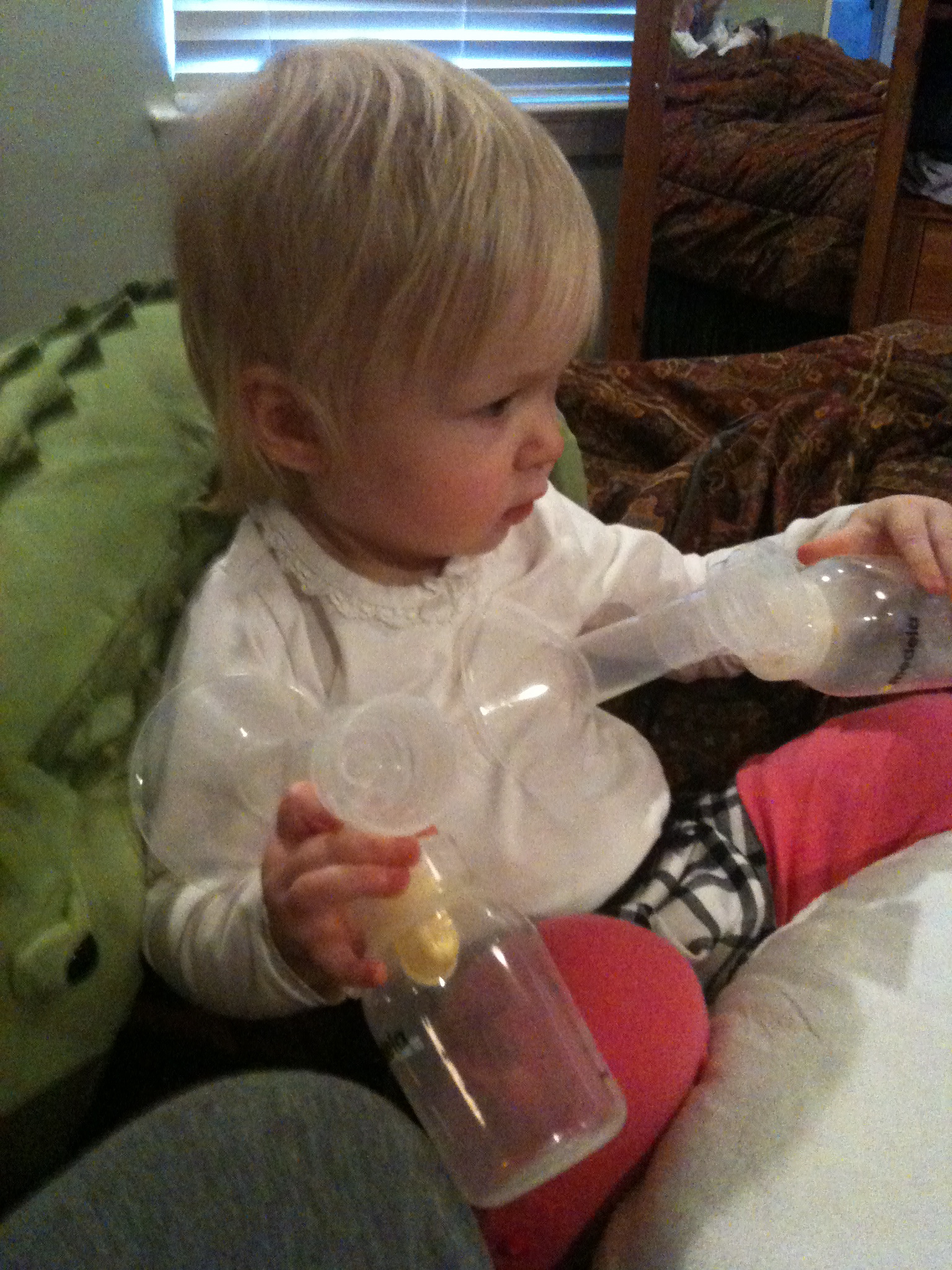
This might be one for Eliza’s senior yearbook page. She enjoyed “pumping” like her mommy when Zach was born.

It doesn’t take long to realize that your children will embarrass you.  But I am pretty sure – and only time will tell if I’m right – that some day we get to embarrass them back.

A friend recently posted on Facebook that her four-year-old daughter yelled to everyone while arriving at preschool, “We didn’t brush my teeth this morning so I have gum.”  I had to laugh because not only do my kids not brush their teeth every morning, but because every day our young kids can make us want to crawl into a hole, and most of the time, unknowingly.

Even when they’re infants, they can scream at the most inopportune times.  They can poop out of their diapers in the grocery line, when you’re almost done and can’t really walk out of the store.  They can pull off mid-stream while nursing, and even render your hooter hider useless as your breasts turn into fire hydrants.

The 18-month to 3-year age range brings along with it multiple public displays of crying, whining, screaming, and tantrums that include lying on the ground with fists banging and legs flailing.  Let’s be honest – who hasn’t’ seen that and thought, “That parent needs to get ahold of that child!”

Zach is still a screamer and whiner.  I know I’ve been mentioning this for, oh, half his life.  I have done some research because I’m nervous that he is never going to grow out of it.  He is easily frustrated and resorts to the loudest or most annoying sound he can make to cope.  Of course, this would be a great place to insert (via comment) your tips.  But I digress … I cannot tell you how many times I have felt the stares from everyone around me in stores, restaurants and the like.  We just returned from a weekend trip. At the airport, as I do often, I shared a bathroom stall with both kids, who proceeded to  wrestle while I was (not) peeing in peace.  Mid-stream, their playing turned into a fight.  I reached over and pulled them apart, shoving him one way and her the other.  Zach, of course, fell (hurled himself dramatically) to the floor and began to wail, “Mommy, why you pushed me?  You huht me, mommy!”  I was mortified, seeing as there were others who could hear us.  I often wonder how bad of a mom those witnessing me could possibly think I am.  And as if Zach still being in this phase weren’t enough, he’s entering the “embarrassing questions” phase that Eliza has been in for two years.

Eliza likes to ask just about all women if they have babies in their tummies.  In the spring, she asked an overweight co-worker of my mother-in-law this question.  The woman very sweetly responded, “No, sweetie, I don’t have a baby in my tummy.”  Eliza couldn’t resist: “Well then why does your belly look like that?”  Without missing a beat, the woman replied, “Because I’m fat.”  Another time Eliza asked my well-endowed friend, “Why are your boobs so much bigger than my mom’s?”

When walking out of church this summer right next to a disabled man, Eliza said, “Mommy, why does he have those sticks?”  I said, “Those are called crutches and they help him walk.” Eliza: “But why?” Me: “Well, because he’s a little different than us, so he walks differently.” Eliza: “But mommy, why is he sad?” Me:  “I don’t know that he’s sad.”  Eliza: “Why is he grumpy?” Embarrassed and lying: “Sweetheart, he’s not grumpy” (as I noticed him scowling at us).

These moments are really just part of life with children.  And I am pretty sure the embarrassment doesn’t end, but rather evolves.  I can’t wait for their tween and teen years, if only because I know my very presence will be embarrassing at times.  It will be payback for all these memories we parents have and will enjoy reminding them about in front of their crushes.  It’s part of the circle of life.

So kids, enjoy the upper hand for now.  It won’t be long before I’m dropping you off at the mall to meet your friends, kissing you all over and being certain to remind you out loud that the money I’m handing you is for your very own training bra or jock strap.

Parenting lesson #8: You cannot plan on being spontaneous anymore.


Our neighbor babysat for us on my 30th birthday, when Greg surprised me with a dinner at one of my favorite restaurants and about 40 friends. And Eliza was about 8-months-old.  See, you can still get out!

Before children, there is a spontaneity that even the most scheduled people get to enjoy in life.  Once baby arrives, the freedom to get home from a long day of work and decide, “Let’s try that new Asian fusion restaurant” goes right out the window.  Asian fusion becomes Chinese delivery, or if you’re lucky, Thai takeout – and you might get into a fight over who gets to go pick it up.

I remember before kids, Greg and I were spiffed up and heading out on a Friday night as a neighborhood family was playing out in the street together.  They whistled at us and asked what we were doing.  I said, “Oh, we’re just going to dinner and a movie.  It’s nothing special.”  And they replied, “Nothing special?  Just dinner and a movie?  For us, that’s Dominos and Netflix.”  We laughed.  But now, I so totally know what they meant.  A nice dinner and a movie date night would cost us at least $150, after paying for food, drinks, theater tickets, and a babysitter for 5 hours.

Getting out looks a little different now.  Last week, it was a bit sad to realize that our dinner date was a 5 p.m. visit to Outback Steakhouse with the kids and half of the geriatrics who live in Leisure World.  Eating with kids is already an experiment in trying to finish a conversation amid 46 interruptions.  But for some reason, your children know you really want them to behave in a restaurant, so they bring their A games of infighting, whining, and questioning.  (“WHaaa, I dropped my crayon!” “Mommy, can we get dessert?” “Why is that lady’s hair purple?” “Zach’s touching my picture!” “I want bread.  I want bread.  I WANT BREAD!!!”).  Not only that, but it’s a tough reminder of what your social life has become when you overhear, “What is Sangria?” at the table next to you.  (True story.)

I don’t think that before you have children you can plan for how potentially trapped you might feel by not being able to just “get up and go.”  But as I sat at Outback last week, I realized that almost exactly 4 years earlier, we were there for Greg’s birthday with 3-month-old Eliza.  And at that time, I felt trapped.  I was overwhelmed.  I was adjusting, rather poorly, to our new lifestyle.  Yet last week, despite all the reminders of how life changes with kids, I wouldn’t want it any other way.

So embrace chucking spontaneity out the window.  Sure, you have to remember diapers, wipes, bottles, formula or breast milk, spare outfits, burp cloths, pacifiers, and maybe even a pump for a restaurant visit.  And you might go to Outback instead of the hip new place where people will stare at kids being kids.  But getting out with a baby beats the alternative.  And hopefully you can count on good friends, neighbors or family to do some free babysitting so you can try the new Asian fusion place after all.  You just have to do a little advance planning.

Parenting lesson #28: It won’t be long before your children challenge you intellectually.


Every parent will feel at some point like he is the only one who deals with a particular behavior.  Sometimes the way your children act makes you think there couldn’t possibly be another child like this.  For me, I have often wondered if my children ask more questions than any other child has in the history of the human race.

The good news is that I now believe the inquisitive nature of my two is actually universal.  Answering questions is par for the parenting course it seems, especially between the ages of 2 and 4.  (Please, someone with older children, tell me it gets better, perhaps if only because they’re in school 7 hours a day and their teachers get to take on a portion of this responsibility.)  The thing is, it’s not that I necessarily mind answering lots of questions.  I simply don’t think I was prepared for the sheer volume I would have to tackle, nor for the challenge some questions would present.  By the afternoon on most days, I find that my brain is exhausted from trying to find the best way to answer each question in a way that gently forces these kids to think while at the same time satiates their curiosity for information from a trusted source.  My head rarely has time to process anything without background noises or interruptions such as screaming, fighting, giggling, singing, or direct questioning.  Sometimes, the questions are simple.  But more often than not now, they require a bit of thought.  I find that questions these days fall into three categories:

1. Permission questions – These are the easiest because the answer is almost always “Yes” or “No,” and I can generally get by with a little explanation and the conversation is over.  “Mommy, will you help me wipe?”,  “Mama, can I pour the syrup?”, “Mommy, can I go to the bathroom outside like Abbey (our dog)?”  Granted, if the answer is “No,” I generally assume I have to support my response with reasoning to preempt the inevitable, “Why not?”  But thinking through these responses has become second-nature to me at this point.  My brain is programmed to answer them.

2. Ethereal questions – “Why are there bad people?”, “Why does God love me?”, “What does Heaven look like?”  These are actually my favorite questions, because they can lead to the most interesting conversations, and generally ones that we need to have.  The problem is if they come after answering 27 factual questions (to be addressed below) and I’m just tired.

3. Factual or “How does the world work?” questions – Eliza is starting to ask more and more of these, and they’re getting more complicated.  This is where I’m struggling.  When she asks, “Why do you have hair in your butt?” I have to bite my cheek to prevent giving my AP bio teacher’s scientific explanation, and just say, “Everyone gets hair there when he grows up,” quietly hoping that it’s enough of an answer to prevent further questioning.  (So far, it’s worked.)  She is no longer satisfied when my answer to “Why does it rain?” is because God knows the plants, flowers and animals need it to survive.  She now wants to understand the clouds and the amounts of rainfall and why it’s raining here and not over there.  I’m starting to have no idea how to answer some of her questions.  In one afternoon in the car last week, I wrote down just a few of her inquiries:

“Mom, will different kinds of rocks hurt you?”  “How do you survive?”  “What will happen if we drive onto the sidewalk and fall backwards onto the roof if your seatbelt is not on?” “Why does music play for us?”

The thing about these questions is that they often require copious amounts of discussion.  If I respond, “What do you think will happen if our car flips over and we’re not wearing our seat belts?”, she will say that we will get hurt, but then want to know how extensive our injuries will be.  As questioning continues, she often gets me to, “I am not sure if I’m going to be able to answer that question in a way that will satisfy you,” or “I just don’t know.”  And sometimes, I just want to hear one song in the car that’s not Veggie Tales or Little People singing Christmas songs and allow my brain to wander wherever it wants for 3 straight minutes.

The funny thing about being in this season is that I used to feel so un-challenged intellectually by parenting infants and toddlers.  But now I find myself being challenged daily by the questions.  And it’s starting to matter whether I get it right.  It’s a somewhat scary and simultaneously exciting time.  Despite the daily inquisition, I really am enjoying Zach and Eliza these days.  There’s a bit of nostalgia already sprouting for their “younger days”; a realization settling in about how quickly time flies and how fast they grow.

I guess I would be okay with it even if my kids did ask more questions than any others in human history (and I know they don’t).  The truth is that even though they are just like every other curious pre-schooler, they are completely unique.  And I am thankful that they DO come to me for answers.  I am pretty sure that someday, they won’t want to.  And then I’ll reminisce about the days when they couldn’t get enough of me, asking hundreds of funny, silly questions a day.

Don’t eat the marshmallow!


If you were four-years-old, could you resist these?

It is really hard work to teach children how to work hard.  Zach and Eliza often take the easy road.  Here are a few examples:

Eliza: “Mommy, can you do motorboat with me?”  Me: “Sure, after you get those horses off the bottom of the pool.”  Eliza: “I don’t want to do motorboat.”

Zach: “Mommy I want eye keem (ice cream).”  Me: “Zach, after you eat your dinner you may have dessert.”  Zach: “Mommy, I want eye keem.”  Me: “Sure, after you eat dinner.”  Zach: “No mommy.”

(And while getting out of the car) Eliza: “I want to carry everything by myself.”  Me: “Eliza, this is a lot of stuff, are you sure?”  Eliza: “Yes.”  (Here are your lunchbox, backpack, jacket, sandwich, and painting.)  E: “Mommy (crying hysterically) it’s too much I can’t carry it I need help I’m AFRAID OF CARS!!!”

In some cases, they’re trying to establish their independence, and in others, they obviously do not want to do the work required to get what they want.  Part of our jobs as parents is to figure out which of those is happening and adjust our reactions accordingly.  And when it is obvious that they are being lazy, I am trying to come up with ways to help motivate them.  I think humans often give up easily if what they’re doing requires effort or discomfort, or if they have to be patient for longer than they deem worthy (which, for my children right now, is generally anywhere between a millisecond and a few seconds).

So how do I convince them to work for what they want?  Or to have self-control and patience?  I have read about the famous marshmallow study.  What is so scary to me about this study is how great a predictor it is for later success.  Kids in the test who delay gratification do well in life; kids who can’t, don’t.

Now that Eliza is four-years-old, I have started going over a responsibility chart with her each night.  She has five things on the list every day, and my goal is not to nag her about them, but to ask her once to feed the dog or unload the silverware from the dishwasher, and if she chooses to do her chores, she gets stickers.  If she does all five chores, she gets a quarter.  If she does four, she gets a dime; three, she gets a nickel; two, she gets a penny; and one or none, she gets nothing.  At the end of the week, if she has 30 or more stickers, she gets a $1 bonus.  This is working well because she is taking pride in doing the work and putting up her stickers.  She gets to control things.  She can choose to do her chores and be rewarded, or choose not to and accept the consequences (not getting stickers and coins).

And when we go to church on Sundays, there are doughnut holes.  When we arrive, she gets to choose whether to eat one immediately, or wait until her class is over and get two.  So far she has chosen to wait two-out-of-four times.

With Zach, we are teaching him that we mean what we say, so that when he doesn’t eat, he doesn’t get dessert.  He definitely shows us through crying and screaming that he is unhappy with us, but he’s learning that his choices have consequences, too.

I guess this is just another example of how it’s hard to know exactly how to teach your kids what you deem to be important.  I don’t want to be so rigid and ruled and stressed about making sure we cover all these “important” things that we don’t have time to be silly and messy and spontaneous.

Yet again, I’m struck by what hard work parenting actually is.  If you have ways you are helping your children learn to be patient and self-controlled, let me know!  I love getting help and suggestions from other parents.  And now that I’ve finished my work (writing this blog), I’m going to go have some tea and cookies.  And perhaps a marshmallow, too.

Parenting lesson #3: You are embarking on a new phase in life that many see as an invitation for unsolicited advice and judgment.


They certainly look like a fun way to pass the time …

As with everything else, not everyone will agree with you when it comes to parenting.  And it seems like more so than in any other occupation, family and strangers alike feel the need to voice their opinions about the job you’re doing.  It’s possible there’s nothing else we do in public that’s as judgment-inducing as how we deal with our children.  When you have a newborn and you’re already nervous about being out, inevitably some little old lady will tell you that your baby – who is in a fleece sleeper and covered in blankets – is cold.  When Eliza was four-weeks-old and I was dealing with feeding issues, my mother-in-law came to visit.  I had just fed Eliza and she was crying.  My MIL said, “Do you think she’s hungry?  Why don’t you just give her some formula?”

I wish I could say that these unsolicited remarks end at some point, but they do not.  It happened to me Wednesday while traveling alone with the kids, and I know it will happen hundreds more times.  After spending 1 1/2 hours driving to the airport, and the next 1 1/2 hours going through security and traipsing the kids across the terminal for 3 gate changes, I was already spent.  Honestly I was just thankful I hadn’t lost my kids in an elevator or bathroom.  But the wait wasn’t over.  There were storms that were keeping our plane circling above, and in the end, our flight was delayed an hour-and-a-half.  When your kids are at the past-exhausted, giggly, we’re going to hit each other because it’s funny mode, you can only do so much.  I decided that getting them some exercise on the moving walkways was a good way to expend energy and pass the time.

Once there, I felt a little like perhaps this wasn’t the best decision.  I didn’t want to be in the way of people hurrying to make their connections.  I did a decent job keeping the kids to the right so people could pass on the left.  Regardless, there was one older couple traveling with a single female companion, and they all huffed and puffed as they walked around us and threw me disapproving glances.  Then the single companion said to my kids after passing them, “Children, hold on to the railing!”

In some ways, it’s entirely annoying that others – especially strangers – do this.  I am not perfect and I might not always make the best decisions, but I would appreciate it if people assumed I have thought through what I’m doing.  Were my children in danger of falling?  I don’t think so.  Were they in the way of others?  Perhaps a little.  Did their presence on the moving walkway hinder anyone?  Maybe by a few seconds.  But honestly, if you’re a stranger and you want to help a parent, sending dirty looks at her is not helpful.  If this woman had looked at me and said, “Do you need some help?  Would you like me to hold their hands and help you get through the walkway?”, I would have known she was concerned for their well-being, not trying to chastise me for what she thought was carelessness.  There’s a part of me that wishes I would have reacted how Greg would have reacted, which would have been by saying, “Yes, and kids, remember not to speak unless spoken to.”

I really hope that regardless what stage I’m in with my kids, I give others the benefit of the doubt, and if I really want to be helpful, that I’ll offer actual help, not judgment.  When I see a woman holding her baby in one arm and feeding her toddler some candy with her other while loading groceries into her car, I’m going to offer to strap her baby into his car seat or load her groceries, not shake my head at her for giving a toddler candy.  Because I’ve been there, and I don’t want to forget what it’s like to live that tough moment.

This parenting journey is hard, with lots of twists and turns.  Sometimes what we need least are these opinionated naysayers.  But if we can laugh it off, and perhaps take any bit of truth from these incidents for the next test, it’s all part of the experience – the wonderful, challenging, beautiful experience.

A “get your kids to eat veggies” idea


Okay, I’ll be the first to admit from the get-go that this idea is laborious and geared toward home cooks.  But I seriously think I came up with a great idea while driving home and salivating over the August issue of Bon Appetit.  (And even those who “can’t cook” can steam, roast in an oven, and defrost a bag of frozen veggies).

For 20 weeks from spring to fall (May to October), do a Family Veggie Challenge.  The idea is to come up with rankings for 20 different vegetables as a family to see which vegetable wins out as your family’s favorite.  I think I will wait to try this next year when Zach and Eliza are both a little older.  (So if you try this, please send me your feedback!)  Here’s the gist:

1. Each week, pick a vegetable to show-case, based on what you can get freshest in the grocery store or farmer’s market.

2. For that week, include one vegetable prepared 3-4 different ways (for consumption at 3-4 of your dinners).  Obviously, this won’t be the only vegetable you eat all week, but it needs to be showcased enough for you to try it several ways without making everyone sick of it (so perhaps every other meal).  You can even eat the vegetable out at a restaurant for one of the nights.  You can try including them in your dinner menu raw, roasted, grilled, sautéed, batter-fried, or steamed.  Of course, you can be creative and search for top-ranked recipes online.  The idea is to make them taste GOOD and not to over-do it by combining the vegetable of the week with too many other ingredients (so your kids really understand the flavor of each veggie).

3. Print up rating cards for each family member for the week and create a rating system (such as “Ew, gross”, “I can swallow this without gagging”, “These actually taste good”, and “Personal favorite”).  At each meal, write down each preparation in a left-column (such as “steamed broccoli with cheese sauce,” “roasted broccoli,” “raw broccoli,” and “tempura broccoli”) and create a chart for people to mark which ratings they choose.  Discuss how everyone has rated the vegetable each night.

4. Each week, declare a winning recipe for each vegetable based on which preparation had the best ratings overall, and collect the rating cards.

5. At the end of the 20 weeks, have your kids declare a winner – the best vegetable.  And you will not only have tried 20 different vegetables, but also 60-80 different recipes for making them.  My guess is that even the pickiest eaters will enjoy tasting for the sake of being able to rate them (even if just about every rating is “Ew, gross!”).  And in the end, you will have a documented reference bible for what vegetables your kids like the most and how they like them best prepared.  You can also give your kids free passes from 3 vegetables at the end of the challenge, so they can choose to not to eat those when you serve them.  (It really is hard to force your child to eat something and watch it come back up through the gag-and-vomit process.  They’re just not going to like every vegetable.)  This would make them have to choose their very least favorites, and would probably help get them to eat the other vegetables that they can get down without gagging.

I’m so excited about trying this out!  Maybe I’ll do a five-week trial this fall.  I think we need to get Zach a little better at consuming food at dinner-time before starting.  Let me know what you think about it!

Life is precious and fragile and painful; yet in my God, there is hope.


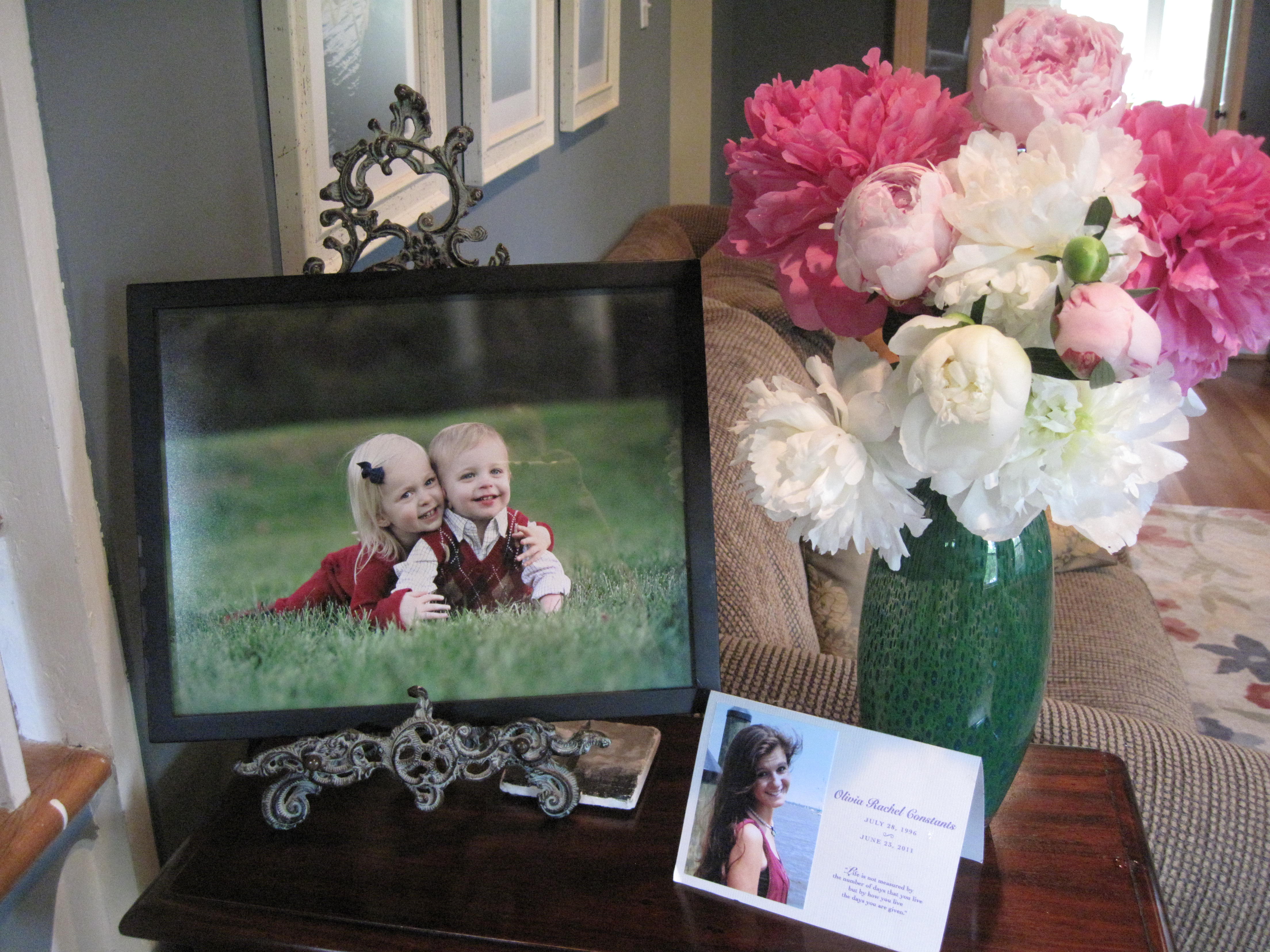
Olivia’s photo at our front door, with peonies, which fittingly represent healing and life.

Sometimes there is no explanation for tragedy except that we live in a fallen world.

Recently we marked the first anniversary of the loss of our dear friends’ daughter, Olivia. We still keep her photo up in our living room as a reminder to cherish every day we get with our children.  And today, I cried through yet another miscarriage with a friend.  I have almost heard about as many miscarriages among my friends in the past few months as I have heard about successful pregnancies.

I do not know why God has created me to feel others’ losses so deeply (as I leak tears onto my chest while typing).  I just do.  So many things on this earth make so little sense to me.  How could a family that wants a baby so badly lose a child?  Why would God allow Olivia to drown?  And don’t get me started about all the other injustices in our world, such as hunger, and child prostitution, and slavery, and corporate greed, and … (that’s me getting started and now stopping myself).

I really do trust that my God is a good God.  I know it deep within my soul because I’ve seen it time and again.  I just walked through an amazing miracle in Greg’s uncle’s life, where we prayed for an inoperable cancerous tumor to disappear, and it did.  (The doctor’s could not explain it, but I can.  Praise Jesus!)  Today, despite the news of loss, it is my mom’s 60th birthday, and I’m so thankful and blessed to have her around and healthy.  I love you, Mom.  And I’m sorry that the world now knows how old you are.

I believe that God wants to bestow the best blessings on us, ones that we wouldn’t even know how to ask for because his plans are better than ours.  The only way I know how to walk through these sufferings is to remember that Jesus suffered in my place; that as a parent, I could not imagine loving others so much that I would allow my own child to suffer and die to save someone else (as God did with Christ).  And I have hope that God uses all things for the good of those who love Him and are called according to his purpose.  (Romans 8:28)

I think one of the greatest things I’ve learned by becoming a parent is how to walk alongside those who are suffering.  I look in those precious little faces of my children daily and am reminded how much I could lose at any moment.  When someone I know is going through a tragedy, the best thing I know to do is love on them and serve them.  I cook for them.  I pray with them.  I shed tears for them.  I am honest with them when I am at a loss for words, because I know saying nothing at all is worse than saying the wrong thing.

Until I am in heaven, suffering and loss will be a part of life on this earth.  The Lord gives and the Lord allows things – precious things – to be taken away.  Even so, blessed be the name of the Lord.  I thank Him for the hope He gives me.  (Job 1:21, Jeremiah 29:11, Romans 5:2-5, Romans 12:12, and Romans 15:13).

For A, J, J, and G.

My child cured my road rage.


If one of these cut me off, I’d probably be okay with it.

At least for a day, seeing as I haven’t driven yet, Eliza has fixed my road rage.

Since having children, this is yet another thing that has changed.  When I first had Eliza, I thanked God that she couldn’t understand a word I was yelling (and sometimes cursing) at other drivers.  When she started to talk, I realized she would repeat pretty much everything I said, especially if it made me laugh.  Remember dammit?

Now, I have one repeater (Zach) and one “mommy” (Eliza).  Eliza is very maternal, likes to tell people what to do, and likes to correct them.  (I know you’re laughing right now if you know me at all.)

Last night, we were on our way to her very first dance recital, and I was concerned about not getting good seats, so of course, every other car on the rush hour road was a serious hindrance to my plans.  I’ve changed, though, in the sense that I now simply talk down to other drivers instead of yelling at them.

“Really?  That’s what you’re going to do?  Thanks – a turn signal would have been nice.”

“Oh, please, cut in front of me, because what you have to do most certainly must be more important than what I have to do.”

Does this sound familiar to anyone else?  I was in the middle of having some of these one-sided conversations with the people on the road.  And Eliza said, “Mommy what are you doing?”  And I said, “I’m just talking to the other drivers.”  Then she said, in a calm and slightly condescending manner, “They can’t hear you, Mommy.”  Of course Greg had to chime in, “I’ve been telling your mommy that for years, Eliza.”

Perhaps he has.  Maybe it’s easier to learn from your innocent children than it is to do so from your spouse.  But when she said that to me, for some reason, I didn’t want to respond with, “But it makes me feel better.”  I didn’t have anything to say for myself.  I was just quiet.  She was right.  They can’t hear me.  From now on, I’m going to try to stop talking to them.  I have no idea if it will stick, but at least for the moment, she has me contemplative and cured.